We did very little vegetable gardening at our Chicago house. In our last couple of years there, we put in a small raised bed and successfully grew radishes, cucumbers, and lettuce, but then I got busy with other stuff and left the garden to go feral. (You're welcome, bunnies!)
Growing food has always been a desire of ours, and now we finally have the space to do it right. TMCH and I plotted (ha!) our ideas independently, and are gradually phasing them in. He put in a raised bed on one of the burn scars south of the house, for direct outdoor planting. Instead of planting in rows, he's following the principles of Square-Foot Gardening. The bed is surrounded with logs (of course) and filled with bagged garden soil. Long-term, we'll think about getting several yards of soil delivered, but Year 1 is for low-cost experimentation!
So far, TMCH has planted spinach, onions, carrots, and lettuce. Despite the often sub-freezing overnight weather and a very amusing 21-inch snowfall on May 11, his little seedlings are popping up and looking good!
Meantime, I decided to try starting seeds indoors for the first time. I invested in a cheap shoplight with daylight spectrum bulbs, a couple of plastic humidity trays, and some seed-starting mix. I also "liberated" some large aluminum baking sheet-type-things from a "Surplus" pile in the hallway at work. They make lovely sturdy drip trays. I set up in the laundry room with the light on a timer, and planted all sorts of stuff.
The tomatoes, cauliflower, and broccoli I recently transplanted into larger containers with soil and compost. I planned to do the same with the peppers, but time and weather have really not been conducive lately. When transplanting, I learned that one plant per cell really is ideal.
If you have multiple seedlings in one cell, getting their roots
disentangled is tough, and pinching off all but one seems so heartless! I water as needed with a weak solution of fish emulsion. It seems to do a great job but holy cow does it smell bad. On the plus side, the dogs love me!
Yesterday afternoon I started the "hardening off" process. Hardening off, it turns out, means "take your plants outside, totally forget about them, leave them out overnight, then shrug and say 'They didn't die so I guess they're done hardening off.'" I'm not sure this was the lesson I was supposed to learn, but whatever works, right?
Next weekend, I plan to get all these juniors into containers. I will probably keep them all inside the yard to protect them from the deer. The rabbits, however, are another story...
Monday, May 19, 2014

Saturday, April 12, 2014
Almost 2 years after the High Park Fire
The 2012 High Park Fire, and the 2013 flood (it doesn't get a fancy name, it's just The Flood), underlie every thing that happens here in Rist Canyon. Neighbors who decided to rebuild post-fire are slowly returning, families are still fighting with insurance companies, and parts of Buckhorn Canyon are still impassable after the roads washed away. A plague of locusts is wryly predicted this year. We and many others have received dire-sounding letters from our insurance companies about fire mitigation steps that must be taken OR ELSE.
Even though our house survived both fire and flood, the wet ground saturated the bases of our many dead, burned trees and weakened them into mush. Ever since last September, we've been hearing the crash of falling trees in the woods, sometimes really close by and sometimes resulting in inconveniently blocked trails. The trees would have fallen eventually, but the flood has hastened it.
Today I took a walk with Foley into the lower part of the woods, by the mill site where the logs for the house were milled back in the late 1970s. The site was still intact when we visited in April 2012. Now it's an array of charred things - axles, cinder blocks, fencing, mysterious hunks of iron. The fire burned hotly there. There were so many trees down that the usual walking path was impassable.
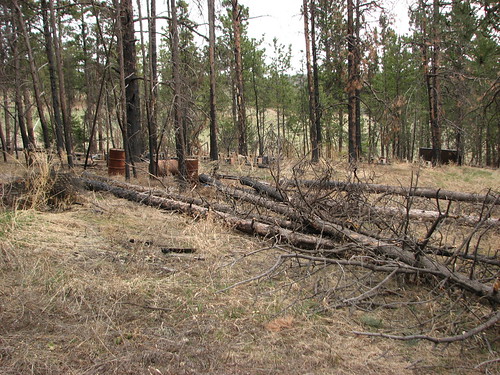
Oil drums, cinder blocks, an old solar water heater panel, and a lot of trees that fell since last fall
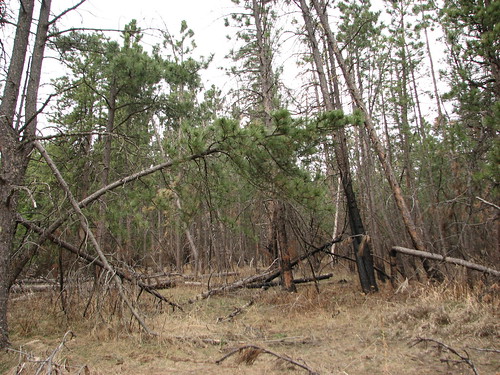
Even trees that survived the fire often became bent from the heat

Dead, burned, flood-weakened trees break off at their bases
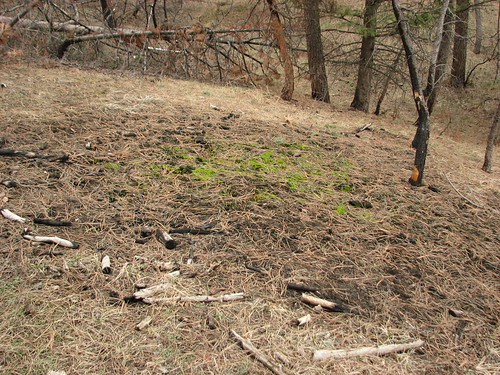
Blackened circles of ground, usually where a treeful of needles burned hotly, are starting to be filled in with moss, an early successional plant that will help to reestablish organic matter in the soil
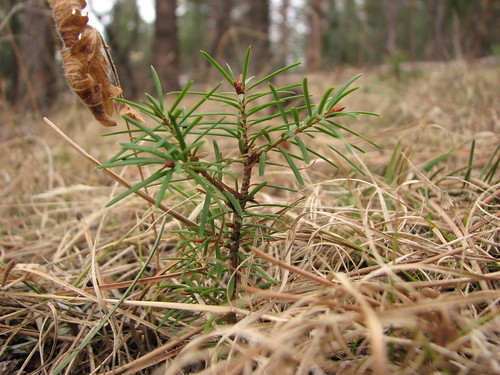
I saw lots of baby Douglas-firs. Doug-firs are not shade-tolerant, but the fire opened up areas of the Ponderosa-pine-dominated canopy and has provided opportunity for the Doug-firs to spring up. These seedlings are a reminder that the fire is part of the normal ecology here, and someday the forest will return.
Even though our house survived both fire and flood, the wet ground saturated the bases of our many dead, burned trees and weakened them into mush. Ever since last September, we've been hearing the crash of falling trees in the woods, sometimes really close by and sometimes resulting in inconveniently blocked trails. The trees would have fallen eventually, but the flood has hastened it.
Today I took a walk with Foley into the lower part of the woods, by the mill site where the logs for the house were milled back in the late 1970s. The site was still intact when we visited in April 2012. Now it's an array of charred things - axles, cinder blocks, fencing, mysterious hunks of iron. The fire burned hotly there. There were so many trees down that the usual walking path was impassable.
Oil drums, cinder blocks, an old solar water heater panel, and a lot of trees that fell since last fall
Even trees that survived the fire often became bent from the heat
Dead, burned, flood-weakened trees break off at their bases
Blackened circles of ground, usually where a treeful of needles burned hotly, are starting to be filled in with moss, an early successional plant that will help to reestablish organic matter in the soil
I saw lots of baby Douglas-firs. Doug-firs are not shade-tolerant, but the fire opened up areas of the Ponderosa-pine-dominated canopy and has provided opportunity for the Doug-firs to spring up. These seedlings are a reminder that the fire is part of the normal ecology here, and someday the forest will return.
Wednesday, March 19, 2014
Still alive!
It's been over a year since I posted! What the heck?!
Right now I'm very much missing my old blog, which I largely used to unload and vent and complain about stuff. Having a place to vent is pretty useful sometimes. I've been working at Colorado State University since April 2013. It's mostly good but the last week has been especially difficult. I'm experiencing the joys of being a whistleblower, and the crushing feelings of guilt and betrayal that go along with that. Hopefully it will all blow over but for now I'm pretty unhappy. General emotional instability is making me feel constantly weepy and prone to bouts of crying. Last night at the grocery store I caught sight of the Apple Jacks and started crying for Jazzy, who's been gone for over 7 years now. Sheesh.
Focus on the good! I've been having such a good time watching eagle nests on webcams. The Berry College (Georgia) nest has one eaglet, and he's the cutest little drunkenly swaying thing! Watch Here
Then there's the Decorah, Iowa nest. I've watched this one for several years. It's still just eggs at this point but hatching should happen in the next couple of weeks. Mom and Dad are beautiful and fierce.
First tiny peek of crocus leaves coming up in our garden this week. I have big plans to install one raised bed for vegetables in this spring, down the hill near the gully. Seems like a good way to hide one of the (many) burn scars. I've been pinning ideas for building raised beds on slopes, like this:

Hopefully we can build it with logs. The one thing we have NO shortage of, is logs! TMCH and I are trying hard to reuse and harvest items from our land whenever we can. Plus, I picked up a few bags of free compost from Whole Foods last year. Free is good!
Right now I'm very much missing my old blog, which I largely used to unload and vent and complain about stuff. Having a place to vent is pretty useful sometimes. I've been working at Colorado State University since April 2013. It's mostly good but the last week has been especially difficult. I'm experiencing the joys of being a whistleblower, and the crushing feelings of guilt and betrayal that go along with that. Hopefully it will all blow over but for now I'm pretty unhappy. General emotional instability is making me feel constantly weepy and prone to bouts of crying. Last night at the grocery store I caught sight of the Apple Jacks and started crying for Jazzy, who's been gone for over 7 years now. Sheesh.
Focus on the good! I've been having such a good time watching eagle nests on webcams. The Berry College (Georgia) nest has one eaglet, and he's the cutest little drunkenly swaying thing! Watch Here
Then there's the Decorah, Iowa nest. I've watched this one for several years. It's still just eggs at this point but hatching should happen in the next couple of weeks. Mom and Dad are beautiful and fierce.
First tiny peek of crocus leaves coming up in our garden this week. I have big plans to install one raised bed for vegetables in this spring, down the hill near the gully. Seems like a good way to hide one of the (many) burn scars. I've been pinning ideas for building raised beds on slopes, like this:
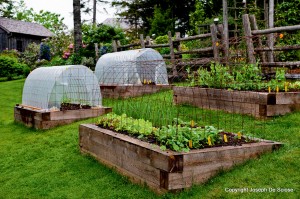
[Image from http://www.seasonalwisdom.com/2013/01/how-to-grow-vegetables-all-year-long-even-in-winter/]
Hopefully we can build it with logs. The one thing we have NO shortage of, is logs! TMCH and I are trying hard to reuse and harvest items from our land whenever we can. Plus, I picked up a few bags of free compost from Whole Foods last year. Free is good!
Saturday, March 2, 2013
I like plants. Have I mentioned that? When we moved from Chicago I had to harden my heart and leave behind, sell, or toss many of my Juniors. The ones I kept were moved into the basement during the house-selling process so they wouldn't look cluttery (except in the basement, of course). Some plants didn't mind the reduced light, others not so much. And the move itself claimed a few little green lives. R.I.P. little Juniors.

Rhipsalis capilliforma, and our truly awful curtains
Two plants in particular, however, not only relished the move, but have thrived beyond my expectations! The first, Rhipsalis capilliforma, Old Man's Beard, was in a south window for years. It grew some, it died some, it was cool but never showed any obvious signs of life or joy. Suddenly now it's growing like a crazy thing, and it's in full flower! What the heck?? I didn't even repot it.

The other plant that is exhibiting unbridled enthusiasm is this Euphorbia tirucalli. This also hasn't been repotted lately, but somehow the southeast-facing window is so much better than its old southeast-facing sunroom that after years of not a single sign of growth at all, it is growing all over the place. I guess having dogs crash into it once in a while does it some good!

Euphorbia tirucalli. New growth is strange and yellow but hey, at least it's growing
Rhipsalis capilliforma, and our truly awful curtains
Two plants in particular, however, not only relished the move, but have thrived beyond my expectations! The first, Rhipsalis capilliforma, Old Man's Beard, was in a south window for years. It grew some, it died some, it was cool but never showed any obvious signs of life or joy. Suddenly now it's growing like a crazy thing, and it's in full flower! What the heck?? I didn't even repot it.
The other plant that is exhibiting unbridled enthusiasm is this Euphorbia tirucalli. This also hasn't been repotted lately, but somehow the southeast-facing window is so much better than its old southeast-facing sunroom that after years of not a single sign of growth at all, it is growing all over the place. I guess having dogs crash into it once in a while does it some good!
Euphorbia tirucalli. New growth is strange and yellow but hey, at least it's growing
Thursday, January 24, 2013
Pruning the Deuterocohnia
Even though my plants are my babies, sometimes I totally drop the ball and neglect one even though it's crying for help. I can't explain why.

I got this Deuterocohnia brevifolia (pretty sure on that ID) at the Garfield Park Conservatory when they had their post-hailstorm fundraiser sale. (The hoya I bought that day died almost immediately.) Carrying this huge thing to the cashier station was one of the most painful experiences of my life. Those spines are SHARP!

I love this sassy, prickly, historical thing. It's unlike my other bromeliads, being terrestrial and desert-adapted, and it's pretty unusual.
So yeah, I dropped the ball. Moving it across the country was hard on it, with those stiff branches getting bent and roughhoused, and then I put it in front of a window where the dogs can knock into it occasionally. I noticed after a few months that some of the stems had died. I put off working on it (did I mention it's SHARP?) but finally sucked it up and did it.

I started from the ends and worked backwards, removing everything dead. There are some remaining stems that may be dying from the proximal ends outward, but since even the living stems look dead at that end, I will wait and be sure before doing any more butchery.
I discovered in the process that the silly plant flowered at some point. D. brevifolia has green flowers so it's not surprising that I missed it.
I also took a few stem cuttings and many leaf cuttings. I don't expect the leaf cuttings to work at all, and nothing online suggests that they could work, but hey, why not try? The cuttings are callousing and will be planted soon. I invested in some rooting hormone to give them a better shot at rooting.
The stems in cross-section are interesting, very fibrous with distinct dark brown vessels. I don't know what special role the brown vessels play. Desert plants are often fibrous because fibers provide strength with very little water content.

The finished product. Fingers crossed for a healthy recovery!
I got this Deuterocohnia brevifolia (pretty sure on that ID) at the Garfield Park Conservatory when they had their post-hailstorm fundraiser sale. (The hoya I bought that day died almost immediately.) Carrying this huge thing to the cashier station was one of the most painful experiences of my life. Those spines are SHARP!
I love this sassy, prickly, historical thing. It's unlike my other bromeliads, being terrestrial and desert-adapted, and it's pretty unusual.
So yeah, I dropped the ball. Moving it across the country was hard on it, with those stiff branches getting bent and roughhoused, and then I put it in front of a window where the dogs can knock into it occasionally. I noticed after a few months that some of the stems had died. I put off working on it (did I mention it's SHARP?) but finally sucked it up and did it.
I started from the ends and worked backwards, removing everything dead. There are some remaining stems that may be dying from the proximal ends outward, but since even the living stems look dead at that end, I will wait and be sure before doing any more butchery.
I discovered in the process that the silly plant flowered at some point. D. brevifolia has green flowers so it's not surprising that I missed it.
I also took a few stem cuttings and many leaf cuttings. I don't expect the leaf cuttings to work at all, and nothing online suggests that they could work, but hey, why not try? The cuttings are callousing and will be planted soon. I invested in some rooting hormone to give them a better shot at rooting.
The stems in cross-section are interesting, very fibrous with distinct dark brown vessels. I don't know what special role the brown vessels play. Desert plants are often fibrous because fibers provide strength with very little water content.
The finished product. Fingers crossed for a healthy recovery!
Tuesday, January 8, 2013
Window garden, part 2
In a sudden burst of creativity, I went to the workshop today and built a shelf for the window. It's 52"x8" with raised sides; no real reason for the raised sides except I thought it would look nice, and maybe it will reduce the chance of pots getting knocked off. Installed, the window trim will form the 4th side. All the wood is scrap pine we had in the garage. The sides I ripped from a ratty-looking 2x4 that was much nicer on the inside.

Now that I know the shelf fits correctly, I just need to give it a quick sanding, stain it, and wait for the cast iron brackets to arrive. (I've discovered the joys of buying hardware on eBay!) And if it all turns out the way I hope, I'll make a similar shelf for my office window, and I can move some of the plants off the Majestic stove.

I mean, it's cute, but it is a *stove* after all.
Now that I know the shelf fits correctly, I just need to give it a quick sanding, stain it, and wait for the cast iron brackets to arrive. (I've discovered the joys of buying hardware on eBay!) And if it all turns out the way I hope, I'll make a similar shelf for my office window, and I can move some of the plants off the Majestic stove.
I mean, it's cute, but it is a *stove* after all.
Monday, January 7, 2013
It's a new year! Let's grow stuff!
One of my goals this year is to finally get a window garden underway. We have a south-west facing window in the dining room that will suit just fine. I dug out my shoebox of seeds and potted up a few things I thought would do okay indoors, mostly leafy stuff.

We have mesclun, cilantro, parsley, basil, rosemary, and thyme (no sage, sadly). Most are from Renee's Garden Seeds or Botanical Interests. I used my usual mix of 2 parts soil (Fox Farms organic) to 1 part perlite (which makes me sneeze!). For now they must live on the table until I get the windowsill shelf built.
We have mesclun, cilantro, parsley, basil, rosemary, and thyme (no sage, sadly). Most are from Renee's Garden Seeds or Botanical Interests. I used my usual mix of 2 parts soil (Fox Farms organic) to 1 part perlite (which makes me sneeze!). For now they must live on the table until I get the windowsill shelf built.
Wednesday, October 24, 2012
Houseplant season
In autumn, a young woman's fancy gently turns to thoughts of...houseplants. Several of my plants died during the move to Colorado--some because I left them on the patio too long (my poor violets!), some because they were stashed in the low-light basement too long, some just from general trauma and perhaps homesickness. I went into a holding pattern for a while, keeping the survivors alive, taking cuttings from semi-rotted succulents, and just waiting for time and interest to catch back up with me.
Finally! I am ready to get back into the swing of things. I had left many plants behind, mostly easy-to-find things like pothos and philodendrons and holiday cacti. This left me with a dearth of hanging plants that I needed to correct. I was thrilled to find a great source of cool plants here in Fort Collins - Fort Collins Nursery. I also received the order I placed with Glasshouse Works a few weeks ago.

New juniors from Glasshouse Works
I'll post more pictures later, and an updated inventory, but for now, here's the plant I won at the Sustainable Living Fair in September. It's a croton, Codiaeum variegatum, very pretty. Unfortunately, I know what happens to crotons in my care! I've had it for a couple of weeks and it's already lost leaves. It droops every two days. According to Mr. Subjunctive, it WILL get spider mites, if I don't kill it first. I'll do my best but sorry, little croton, you may be doomed.

Finally! I am ready to get back into the swing of things. I had left many plants behind, mostly easy-to-find things like pothos and philodendrons and holiday cacti. This left me with a dearth of hanging plants that I needed to correct. I was thrilled to find a great source of cool plants here in Fort Collins - Fort Collins Nursery. I also received the order I placed with Glasshouse Works a few weeks ago.
New juniors from Glasshouse Works
I'll post more pictures later, and an updated inventory, but for now, here's the plant I won at the Sustainable Living Fair in September. It's a croton, Codiaeum variegatum, very pretty. Unfortunately, I know what happens to crotons in my care! I've had it for a couple of weeks and it's already lost leaves. It droops every two days. According to Mr. Subjunctive, it WILL get spider mites, if I don't kill it first. I'll do my best but sorry, little croton, you may be doomed.
Wednesday, October 3, 2012
Cleaning up the aspen grove
Our aspen grove lies between the meadow and the ravine south of the house. The larger trees are about 30 feet tall, and there are dozens of saplings. The High Park Fire burned through much of the grove in June, killing smaller trees and damaging or killing many of the large ones. Since the grove is so visible from the house, and it is our preferred source of firewood (aspen is less resinous than pine), we're diligently trying to clear out the dead trees this fall. For a small grove, it is turning out to be a daunting task, and it sets an ominous tone for the acres of burned pines awaiting our attention.
This was the aspen grove just after the fire, on June 29.
It was easy to see at that time what burned and what did not.
On September 11, we started clearing dead trees. This was taken from the deck just before we started.
Yesterday, this was the grove:
It's impossible to see a difference but trust me, there are far fewer trees now! Even with dozens of dead trees cleared out, there are a LOT of saplings and many larger trees still alive. Once we're done for the season, I will take a picture from the deck for a better comparison.
Some larger trees lost their lower limbs while the tops remain intact.
As I lopped off small dead trees (1 to 1 1/2 inches) in order to increase sunlight to the forest floor, I observed new growth at the base of nearly every tree. Aspens have thin bark, useless against fire, but their underground stems survive and even seem to be stimulated by the heat.
Here is a section that we haven't cleared yet; most or all of these trees are dead:
while this adjacent section didn't burn at all.
There are two piles of logs waiting to be bucked (=sectioned into fireplace-sized pieces).
TMCH built this nifty foldable bucking stand and is sectioning logs as fast as he can. I then put them in the trailer and drive them up to the woodpile. Like all of our neighbors, we are going to have more wood than we will ever be able to use!

This was the aspen grove just after the fire, on June 29.
It was easy to see at that time what burned and what did not.
On September 11, we started clearing dead trees. This was taken from the deck just before we started.
Yesterday, this was the grove:
It's impossible to see a difference but trust me, there are far fewer trees now! Even with dozens of dead trees cleared out, there are a LOT of saplings and many larger trees still alive. Once we're done for the season, I will take a picture from the deck for a better comparison.
Some larger trees lost their lower limbs while the tops remain intact.
As I lopped off small dead trees (1 to 1 1/2 inches) in order to increase sunlight to the forest floor, I observed new growth at the base of nearly every tree. Aspens have thin bark, useless against fire, but their underground stems survive and even seem to be stimulated by the heat.
Here is a section that we haven't cleared yet; most or all of these trees are dead:
while this adjacent section didn't burn at all.
There are two piles of logs waiting to be bucked (=sectioned into fireplace-sized pieces).
TMCH built this nifty foldable bucking stand and is sectioning logs as fast as he can. I then put them in the trailer and drive them up to the woodpile. Like all of our neighbors, we are going to have more wood than we will ever be able to use!
Monday, October 1, 2012
Aspens in autumn
We have our very own aspen grove. It was hit hard during the fire and we've been clearing dead trees out seemingly non-stop, but plenty still stand. In late September/early October, they look pretty amazing.

Thursday, September 13, 2012
The greyhound herself
This is Foley, our big dopey sweet greyhound! Isn't she a doll?

Foley has adapted very well to life in the mountains, after being a city dog most of her (post-racing) life. She enjoys chasing chipmunks and she finds mule deer very interesting. Her turn-ons are cheese, meat, and snuggles. Turn-offs are carrots, thunderstorms, and being left at home.

Foley has adapted very well to life in the mountains, after being a city dog most of her (post-racing) life. She enjoys chasing chipmunks and she finds mule deer very interesting. Her turn-ons are cheese, meat, and snuggles. Turn-offs are carrots, thunderstorms, and being left at home.
Fog
Hey, where did our canyon go?

It drizzled all evening and night and most of the day. The fog advanced and retreated but never left, and the next ridge remained invisible all day. Luckily I had nowhere to go, but TMCH had to find his way down the road after fire department training.
We figured out how to work the propane stove today. After years of having a forced-air furnace, learning to heat a house using wood and propane is quite an adjustment! The stove turns out to be pretty straightforward once you figure out how to light the pilot. It's lovely and toasty to stand in front of. We'll see how charming it is during the dead of winter.
It drizzled all evening and night and most of the day. The fog advanced and retreated but never left, and the next ridge remained invisible all day. Luckily I had nowhere to go, but TMCH had to find his way down the road after fire department training.
We figured out how to work the propane stove today. After years of having a forced-air furnace, learning to heat a house using wood and propane is quite an adjustment! The stove turns out to be pretty straightforward once you figure out how to light the pilot. It's lovely and toasty to stand in front of. We'll see how charming it is during the dead of winter.
Wednesday, September 12, 2012
High Park Fire symposium
On Monday at CSU I attended an all-day symposium about the High Park Fire and its aftermath. I was hoping for two outcomes: learn something useful about our burned land, and get a lead on a job. Partial success on one front, and I did at least find someone to send a CV to "just in case something opens up." Baby steps!
Overall I thought it was an excellent program. The Warner College received an NSF RAPID grant to do some post-fire study and work is already well underway. (Hindered, unfortunately, by the lack of pre-fire data points.) I was as always greatly amused by the scientists' reluctance to commit to a definite answer on anything. I know that science deals in confidence intervals and nothing can ever really be proven to be right, but at a conference like this where homeowners want to know, "What is the best thing to plant for erosion control?", "it depends" or "we're still looking into that" is unsatisfying.

I learned a great deal about hydrology and sedimentation in steep forested areas, a topic I know little about. Evidence from the Hayman fire of ten years ago, and from other fire studies, suggests that most ground cover rebounds within two years except in the most severely burned areas. Seeding may or may not be helpful and is greatly at the mercy of the precipitation that follows seeding. (And today after nearly 24 hours of drizzle, I wish I could go back in time and plant some seed!) Native plants with fibrous root systems are preferable for erosion control, and shrubs are the best. Be cautious of planting for the short-term; perennial grasses may establish so well that they outcompete the shrubs and trees that are supposed to succeed them. Contour log erosion barriers were actually frowned upon by the hydrology guy, who said unless they are perfectly positioned, they can cause even worse eroding rills than the sheeting water they were meant to interrupt.
Only about 47% of the total burn area was moderately to severely burned (per the BAER report). Restoration and erosion control should be concentrated on the most severe areas; the rest will largely rebound on its own. (I believe we have bits of all four severity categories on our land.) A researcher from the Rocky Mountain Research Station mentioned that it is not known how patch size affects regeneration. What an interesting topic that would be to investigate!

Ground cover regeneration seems like it is not something to fret about. Trees, however, are a different story. Aspens regenerate from below-ground stems and in fact are fire-stimulated, so they'll take care of themselves (our own aspen grove is filled with tiny trees). The conifers however tend to produce huge seed crops (mast) only every 4-6 years, and those result in large numbers of seedlings only if they coincide with a good precipitation season. This alignment is infrequent. The Hayman study showed abundant Ponderosa pine regeneration and poor Douglas-fir regeneration after ten years in less-severe burn areas. In the severely burned areas, tree regeneration was poor all around. This is a discouraging result, although the Hayman was just one site and other burns have shown better regeneration. A later speaker mentioned that places where natural reseeding is unlikely are good candidates for tree planting.
Next step for me: investigate our land and see how the rains are affecting those "severely burned" areas, and let that guide our restoration actions. Also, send a couple of "I enjoyed your talk" emails and meet people in my field! I signed up to volunteer with the Colorado Natural Heritage Program as well. As the Alma College career center loved to tell us, It's all about networking. Ugh.
Overall I thought it was an excellent program. The Warner College received an NSF RAPID grant to do some post-fire study and work is already well underway. (Hindered, unfortunately, by the lack of pre-fire data points.) I was as always greatly amused by the scientists' reluctance to commit to a definite answer on anything. I know that science deals in confidence intervals and nothing can ever really be proven to be right, but at a conference like this where homeowners want to know, "What is the best thing to plant for erosion control?", "it depends" or "we're still looking into that" is unsatisfying.
I learned a great deal about hydrology and sedimentation in steep forested areas, a topic I know little about. Evidence from the Hayman fire of ten years ago, and from other fire studies, suggests that most ground cover rebounds within two years except in the most severely burned areas. Seeding may or may not be helpful and is greatly at the mercy of the precipitation that follows seeding. (And today after nearly 24 hours of drizzle, I wish I could go back in time and plant some seed!) Native plants with fibrous root systems are preferable for erosion control, and shrubs are the best. Be cautious of planting for the short-term; perennial grasses may establish so well that they outcompete the shrubs and trees that are supposed to succeed them. Contour log erosion barriers were actually frowned upon by the hydrology guy, who said unless they are perfectly positioned, they can cause even worse eroding rills than the sheeting water they were meant to interrupt.
Only about 47% of the total burn area was moderately to severely burned (per the BAER report). Restoration and erosion control should be concentrated on the most severe areas; the rest will largely rebound on its own. (I believe we have bits of all four severity categories on our land.) A researcher from the Rocky Mountain Research Station mentioned that it is not known how patch size affects regeneration. What an interesting topic that would be to investigate!
Ground cover regeneration seems like it is not something to fret about. Trees, however, are a different story. Aspens regenerate from below-ground stems and in fact are fire-stimulated, so they'll take care of themselves (our own aspen grove is filled with tiny trees). The conifers however tend to produce huge seed crops (mast) only every 4-6 years, and those result in large numbers of seedlings only if they coincide with a good precipitation season. This alignment is infrequent. The Hayman study showed abundant Ponderosa pine regeneration and poor Douglas-fir regeneration after ten years in less-severe burn areas. In the severely burned areas, tree regeneration was poor all around. This is a discouraging result, although the Hayman was just one site and other burns have shown better regeneration. A later speaker mentioned that places where natural reseeding is unlikely are good candidates for tree planting.
Next step for me: investigate our land and see how the rains are affecting those "severely burned" areas, and let that guide our restoration actions. Also, send a couple of "I enjoyed your talk" emails and meet people in my field! I signed up to volunteer with the Colorado Natural Heritage Program as well. As the Alma College career center loved to tell us, It's all about networking. Ugh.
Friday, August 31, 2012
Fire aftermath
The High Park Fire is done but its aftereffects will linger for years. We were fortunate; we lost a large number of trees on our property but the structures were not damaged. Sadly, 259 homes were lost, mostly in Rist Canyon and in Glacier View to the north. The people we've met who lost their homes, including the woman who was the selling realtor on this house, have amazing, positive attitudes towards the destruction, treating it as an opportunity to rebuild even better homes. Of course, we're seeing a biased sample. The people who lost so much that they never want to see this place again--well, they've already left and we'll never meet them. My heart goes out to them.

This week has been filled with aerial reseeding and mulching of slopes in the canyon. With the vegetation gone in so many places, erosion and flash flooding are a huge problem. Access to steep, densely forested areas is difficult so the work is done by helicopter. The same was true for the firefighting effort itself, only now they're spreading seed and straw rather than water. The helicopter landing zone (the "LZ," as my volunteer firefighter-in-training husband tells me it's called) is right across the road from us so we're getting a lot of chopper noise. They leave with a full bag of materials, fly west, and return with the bag dangling empty.

One particular bit of damage I was sad about was the huge mountain mahogany shrub (Cercocarpus montanus) next to the propane tank. The fire reached the tank and scorched it (eek!!) and destroyed the shrub. I saw this morning, however, that it is still alive. Mountain mahogany seems to have an amazing ability to regenerate from its roots; what a good little fire-adapted shrub!

This week has been filled with aerial reseeding and mulching of slopes in the canyon. With the vegetation gone in so many places, erosion and flash flooding are a huge problem. Access to steep, densely forested areas is difficult so the work is done by helicopter. The same was true for the firefighting effort itself, only now they're spreading seed and straw rather than water. The helicopter landing zone (the "LZ," as my volunteer firefighter-in-training husband tells me it's called) is right across the road from us so we're getting a lot of chopper noise. They leave with a full bag of materials, fly west, and return with the bag dangling empty.
One particular bit of damage I was sad about was the huge mountain mahogany shrub (Cercocarpus montanus) next to the propane tank. The fire reached the tank and scorched it (eek!!) and destroyed the shrub. I saw this morning, however, that it is still alive. Mountain mahogany seems to have an amazing ability to regenerate from its roots; what a good little fire-adapted shrub!
Tuesday, August 28, 2012
Welcome to Colorado!
Six months ago, I was a city girl living in Chicago with Too Much Coffee Husband, Foley the neurotic greyhound, and Lucy the always-hungry beagle. I rode the L to campus every day, could get coffee or Thai or Moroccan food within two blocks of home, mouthed off at drivers who tried to run me over in the crosswalk, and ran errands on foot in the Loop. I was also frantically writing my dissertation, chained to the desk in our back bedroom from 8 a.m. until sometimes after midnight (and, to be honest, sometimes much much earlier than that). TMCH and I had other things to do with our lives, but first I needed to finish the beast.
On Friday the 13th of April, I successfully defended. A month later, I had presented it in public, finished revisions, and been approved by the Graduate College. After 7 1/2 years, I was finally DONE.
Then a crazy whirlwind of activity took place, a house was purchased, another was sold, movers were hired, and boom! Rustic log home, 30 acres of Ponderosa pine forest and sunny meadows, and a 17 minute drive to the nearest restaurant. Whoa, what just happened?
I will have lots to share over the coming months and years. Adjusting to country living, learning how to garden at high altitude, and exploring the beautiful lands of Northern Colorado should give me plenty to write about. Stay tuned as I spend lots of money on plants that are all eaten by deer! Be amused as I utterly fail at building a fire in the fireplace! Marvel at the strange meals we concoct because the grocery store is so far away! Share in Lucy's joy at discovering wild turkeys!
This is going to be fun. :)
On Friday the 13th of April, I successfully defended. A month later, I had presented it in public, finished revisions, and been approved by the Graduate College. After 7 1/2 years, I was finally DONE.
Then a crazy whirlwind of activity took place, a house was purchased, another was sold, movers were hired, and boom! Rustic log home, 30 acres of Ponderosa pine forest and sunny meadows, and a 17 minute drive to the nearest restaurant. Whoa, what just happened?
I will have lots to share over the coming months and years. Adjusting to country living, learning how to garden at high altitude, and exploring the beautiful lands of Northern Colorado should give me plenty to write about. Stay tuned as I spend lots of money on plants that are all eaten by deer! Be amused as I utterly fail at building a fire in the fireplace! Marvel at the strange meals we concoct because the grocery store is so far away! Share in Lucy's joy at discovering wild turkeys!
This is going to be fun. :)
Subscribe to:
Posts (Atom)